Camp kitchen · RESEARCH-BASED BUYING GUIDE
Size a Camp Wash Basin Around Your Largest Dish
A wash basin should fit the dishes you need to clean without filling half your kitchen box. Advertised liters do not tell you whether a wide plate fits through the opening. Start with your largest regularly used item and the campsite's actual washing facilities before adding a collapsible sink.
As an Amazon Associate I earn from qualifying purchases. We have not hands-on tested the products discussed in this guide.
Use the largest dish as a template
Measure the diameter of your plate or bowl and the width of any handle that must fit. Compare the basin's opening and base dimensions, not just its volume. A tall narrow container can hold plenty of water while making a broad plate awkward to position. If the maker gives only capacity, ask for the usable interior measurements before deciding it will work.
Compare the shape when in use
Soft fabric, folding rigid panels, and silicone-sided basins have different setup routines. Look at how the rim holds its shape and whether the instructions require a particular fill level. Sea to Summit's Kitchen Sink page, for example, includes use and care constraints that matter beyond packed size. Use those details for the selected product rather than assuming an empty fabric bowl will behave like a household sink.
Plan where washing happens
Confirm whether the campground provides an approved dishwashing station or other disposal rules. A portable basin does not authorize washing or emptying dirty water wherever convenient. Think about the distance between your table and the permitted location, and compare handle placement with the load you can comfortably carry. Separate clean dishes from used items while you are moving them.
Try a household basin first
An existing washable basin may fit your car and perform the job without a specialist purchase. A collapsible version earns its place when storage volume is the repeated problem. Test the complete cleanup kit, including brush, cloth, and drying space. Allow the basin to dry according to its instructions before long-term packing. Avoid buying an oversized set simply because multiple pieces nest attractively in a product photograph.
A plate-versus-volume example
Imagine two wash basins with similar stated capacities. One is tall and narrow, while the other is lower and broad enough for your dinner plate. If cleaning plates is the main task, opening width can make the broader design more convenient even without extra volume. If your kitchen mostly uses small bowls, the narrow shape might fit the car better. Draw the largest dish inside each proposed opening and compare the space needed for both basin and drying area. Also check the campsite's approved washing location before buying. A folding sink has little value if you already have a convenient permitted station and only need a small container to carry dirty dishes there.
Compare the practical approaches
| Approach | Useful when | Constraint to check |
|---|---|---|
| Use the campground dishwashing station | A permitted facility already provides the surface and washing location needed for your normal dishes. | Confirm availability and current site rules. You may only need a suitable carrier to move used dishes, not a portable sink. |
| Existing rigid household basin | The actual plate fits, transport is manageable, and the container fits in your vehicle. | Include the basin’s rigid storage outline and handles; unused empty volume still occupies space on the journey. |
| Collapsible structured basin | Packed height is the recurring problem and you can use a suitable stable working surface. | Read the opening, base, folding, temperature, and cleaning guidance for the specific product; designs do not share identical limits. |
| Light fabric camp sink | A compact packed package is valuable and the intended operating shape suits your dishes. | Check any required fill level and the maker’s instructions. Do not assume an empty fabric basin has the rigidity of a household sink. |
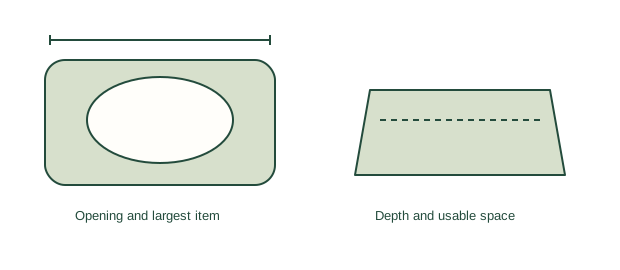
Illustrative opening test: equal liters, different fit
The following example uses invented dimensions, not product specifications. Imagine a dinner plate 26 cm across. Basin A has a 24 cm opening, while Basin B has a 32 cm opening. Even if both carry the same nominal capacity label, Basin A cannot admit that plate lying flat through the stated opening. Basin B leaves a nominal 6 cm difference across the opening, equivalent to 3 cm per side when centered.
That calculation is only an initial screening step. The basin can taper toward its base, handles can interfere, and the space needed to wash comfortably is greater than a mathematical outline. Draw the opening and the base on paper, then compare your actual largest item and the working surface. Do not infer that a 32 cm opening proves a comfortable fit or that every plate should be washed in the same orientation.
Next map the cleanup station: basin, temporary used-dish area, clean-dish area, and drying surface. If the combined layout consumes the entire table, a smaller dish set or use of permitted campground facilities may be a better first change. Follow the current site’s washing and wastewater disposal rules rather than interpreting a portable sink as permission to wash anywhere.
Build a wash-station fit sheet
- Measure the widest regularly used dish, including any fixed handle. Add a note for unusual items such as a broad serving bowl; do not size the entire kit around equipment you seldom bring.
- For every basin candidate, record opening dimensions, base dimensions, and packed outline separately. Mark missing interior measurements as unknown and ask the supplier instead of deriving them from liters.
- Read the specific stability and care guidance, including fill-level requirements and allowed temperatures or cleaning products. These constraints belong to the selected product rather than to all camping sinks.
- Sketch the approved washing location and route from your table. List the clean and used-item carriers you already own, and consider carrying distance before choosing a much larger container.
- Rehearse a complete household cleanup with the dishes you plan to bring. Observe where items wait to dry, then select only the additional equipment needed to fix the actual bottleneck.
Capacity is not an operating instruction
A stated liter capacity describes volume, not the fill level, material limits, or stability of every design. Sea to Summit publishes particular operating and care requirements for its Kitchen Sink. Read the current instructions for the selected size and version rather than copying another basin’s routine.
Is it worth adding to your kit?
Consider it if
Your current basin is too bulky or does not fit the dishes you actually bring.
Skip it if
The campground facilities or a suitable existing household basin meet your needs.
COMPARE FEATURES, THEN CHECK THE LISTING
Explore the options
These are category search results, not a claim that every result fits this guide. Match dimensions, contents, care instructions, and seller details before choosing.
Search Amazon (paid link) ↗We may earn a commission from qualifying purchases. Prices and availability are shown by the retailer.
Common questions
Can capacity tell me whether a plate fits?
No. Compare opening width, base shape, and the plate dimensions.
Can I use it with boiling water?
Use only temperatures and cleaning products allowed by the specific manufacturer instructions.
Sources and editorial scope
Primary references support the product-category examples and documented features. Fit exercises, buying decisions, and existing-gear alternatives are Practical Trail editorial guidance. References were reviewed for this guide on October 13, 2026; specifications and product versions can change. This article does not present independent test results.
How our guides are prepared →