Camp setup · RESEARCH-BASED BUYING GUIDE
A Tent Footprint That Actually Fits Your Tent
A footprint purchase starts with a specific tent, not its advertised person count. Two shelters sold for three people can have different floor shapes and pole attachments. This research-based guide helps you choose an abrasion layer without assuming that a larger sheet offers better protection.
As an Amazon Associate I earn from qualifying purchases. We have not hands-on tested the products discussed in this guide.
Record the tent identity
Find the model name, model year if available, and floor plan in your tent manual. Photograph the corner fittings for your own reference. Draw a rough floor outline with length, widest width, and any tapered end. Keep vestibule space separate: the inner floor and the covered entrance are different measurements. A listing that only says two-person universal gives you too little information to confirm fit.
Compare coverage with actual geometry
Lay the tent floor flat at home and compare the proposed footprint outline. For a generic groundsheet, avoid unintended exposed edges beyond the floor; follow the maker’s instructions for purpose-designed compatible vestibule extensions. Corner cutouts and curved edges matter when the floor is not rectangular. Big Agnes maintains a footprint compatibility FAQ; use the maker's model matching information before treating similar dimensions as proof that attachment hardware will align.
Decide how much convenience matters
A matched footprint usually simplifies alignment, while an existing clean groundsheet may work when carefully folded beneath the floor according to your tent instructions. The folded option can be bulkier and requires attention each time you pitch. Carrying the complete tent and candidate sheet together is a better packing test than comparing separate catalog weights. Include the storage pouch in that comparison.
Make a purchase that survives a model change
If you camp occasionally on established soft sites, first inspect the tent floor and try a careful setup using your existing equipment. Buy the accessory when the fit or extra abrasion protection solves a clear problem. Keep a note of the exact version purchased. When replacing the tent later, check compatibility again rather than assuming your old footprint remains suitable. This is floor protection, not a repair for a leaking shelter.
A tapered-floor buying example
Consider a camper comparing two generic sheets for a tent whose foot end is narrower than its head end. The rectangular option may match the maximum width yet require folding along both lower corners. The matching model-specific option may cost more while saving that repeated alignment work. Put both outlines on paper and decide whether the convenience matters for your trips. If the tent is used twice a year near the car, the existing carefully fitted sheet might be enough. If you frequently pitch and repack the same shelter, a compatible sheet may earn its space through a simpler routine. Avoid unintended generic-sheet protrusion, follow any model-specific extension instructions, and do not rely on a capacity label to establish fit.
Compare the practical approaches
| Approach | Useful when | What to check before choosing |
|---|---|---|
| Matching model-specific footprint | You want the maker’s intended shape and attachments with fewer alignment decisions during repeated setup. | Confirm the exact tent version and any compatibility exclusions. Similar names from different model years do not establish a match. |
| Existing sheet folded to fit | You already own a suitable sheet and are happy to check its position at each pitch. | Follow the tent instructions, avoid unintended exposed edges, and include the folded bulk when comparing the complete packed shelter. |
| Dedicated extended or vestibule footprint | The tent maker specifically offers extra coverage for the intended compatible model and configuration. | Use that design as instructed. A purpose-designed extension is different from an oversized generic sheet unintentionally protruding beyond the floor. |
| Keep the present arrangement | The included or existing protection fits, the floor is in good condition, and no recurring problem remains. | Spend the time confirming your inventory and practice pitch before paying for a replacement that duplicates working equipment. |
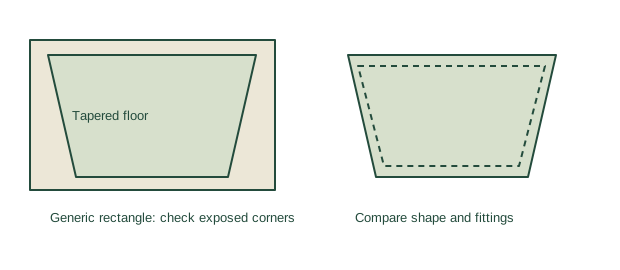
Illustrative fit calculation: the capacity label misses the taper
The following dimensions are invented to explain a measurement method, not specifications for any tent or a tested cutting pattern. Imagine a floor 210 cm long, 140 cm wide at the head, and 110 cm at the foot. A rectangular sheet labeled 210 × 140 cm matches the maximum dimensions but does not follow the narrower lower end. A paper outline makes the mismatch visible before any fabric is cut or purchased.
If the shapes were centered and had straight sides, the 30 cm difference at the foot would leave 15 cm on each side of that end. That arithmetic describes the hypothetical outlines only. It does not prescribe the inset needed for your tent, account for curved seams, or establish attachment compatibility. Follow the manufacturer’s floor-protection guidance rather than subtracting a universal margin from every measurement.
Now compare two practical routes: carefully fold a suitable existing sheet according to the tent instructions, or confirm the matching footprint for this exact version. If the listing omits a floor plan or fitting diagram, ask the maker for confirmation. Keep fabric fit, fitting compatibility, and any optional shelter-mode compatibility as separate questions.
Make a footprint compatibility card
- Write the exact tent name, capacity variant, and model year or revision. Save the manual reference and a private photograph of its corner hardware so you can ask a precise compatibility question.
- Sketch the floor outline and mark measured head width, foot width, and length. Label a curved or irregular edge as uncertain rather than turning a rough tape measurement into an exact cutting instruction.
- Record whether you want only floor abrasion protection or a maker-approved additional function. Keep vestibule coverage separate on the sketch so an intended extension is not confused with an accidental overhang.
- For each candidate, enter “confirmed,” “unclear,” or “not compatible” beside shape, attachment, and version. Pause the purchase when an essential answer remains unclear; a capacity label cannot fill the gap.
- Practice the complete allowed arrangement and repack the dry tent with its sheet and pouches. Keep the card with the shelter kit, then review it if you replace either the tent or footprint.
An important exception to the overhang rule
The advice about avoiding protruding generic groundsheet edges concerns unintended exposed material. Some manufacturers offer model-specific footprints with deliberately extended vestibule coverage. Big Agnes distinguishes those designs in its FAQ. Use the instructions and compatibility information for that specific product; do not imitate an extension by buying an arbitrary larger sheet.
Is it worth adding to your kit?
Consider it if
Your existing sheet is awkward to align or your tent needs a correctly fitted abrasion layer.
Skip it if
The included groundsheet already fits and you cannot identify a problem it fails to solve.
COMPARE FEATURES, THEN CHECK THE LISTING
Explore the options
These are category search results, not a claim that every result fits this guide. Match dimensions, contents, care instructions, and seller details before choosing.
Search Amazon (paid link) ↗We may earn a commission from qualifying purchases. Prices and availability are shown by the retailer.
Common questions
Can I buy by person count?
No. Match the actual tent model or verify dimensions and fittings; capacity labels do not establish compatibility.
Does the footprint replace tent maintenance?
No. Inspect and maintain the tent itself, and follow its setup and care instructions.
Sources and editorial scope
Primary references support the product-category examples and documented features. Fit exercises, buying decisions, and existing-gear alternatives are Practical Trail editorial guidance. References were reviewed for this guide on October 13, 2026; specifications and product versions can change. This article does not present independent test results.
How our guides are prepared →