Luggage accessories · RESEARCH-BASED BUYING GUIDE
When a Small Luggage Scale Earns Its Place
A luggage scale is most useful on the return leg, when shopping or repacking changes your load away from home. It cannot guarantee agreement with an airline’s equipment or prevent a fee. Buy one for a repeatable weighing routine, and check the actual allowance for every booking before relying on the result.
As an Amazon Associate I earn from qualifying purchases. We have not hands-on tested the products discussed in this guide.
Identify the real weighing problem
If you travel with the same lightly packed bag each time, a home scale may be sufficient. Portable scales become more relevant when different travelers share luggage, you bring purchases back, or accommodation has no usable scale. Write down which of those situations you face. A device that solves no recurring problem is simply another object to carry and keep powered or maintained.
Compare the lift and read methods
Some scales retain a reading after you set the bag down; others require you to see the display while lifting. Look at the handle and strap arrangement before the numerical capacity. Practice with a manageable load and keep the bag close to the floor. If lifting your packed case is uncomfortable, ask for help or use an available platform scale rather than forcing a one-handed lift.
Check consistency rather than chasing precision
Weigh the same packed bag several times and see whether the result changes noticeably with your technique. Compare with another scale when convenient, recognizing that neither home measurement is the final carrier determination. Leave a sensible margin below the allowance rather than packing to the last displayed decimal. Include any detachable straps or accessories that will travel with the bag in the actual measurement.
Account for storage and power
A mechanical scale avoids batteries but may occupy more room; a digital one can be compact but needs working power and readable units. Confirm whether the unit shows kilograms or pounds and how it switches between them. A simple protective pouch can keep the hook or strap from catching other belongings. If you only need one departure measurement, borrowing a scale is a reasonable alternative.
Compare the practical approaches
| Approach | Useful scenario | Practical advantage | Tradeoff | Decision check |
|---|---|---|---|---|
| Borrowed home scale | One departure from home with a stable packing list. | Avoids buying and carrying another device. | May not be available before the return trip; the method must suit the scale and load. | Ask whether the return contents will materially change. |
| Handheld scale with retained reading | Repeated weighing away from home. | You can set the bag down before reading where that feature is provided. | You still need a manageable lift and a suitable bag handle. | Check the intended attachment, units and reading-retention instructions. |
| Mechanical travel scale | You prefer a device without batteries. | No battery charging or replacement routine for the scale itself. | Dial readability and packed bulk can matter more than nominal capacity. | Check whether you can read the result comfortably after the lift. |
| Available platform scale | The packed bag is awkward for you to lift by hand. | The bag can rest on a suitable weighing surface. | Access away from home may require planning or assistance. | Confirm availability rather than assuming every hotel or station has one. |
Illustrative numbers: repeatability is not accuracy
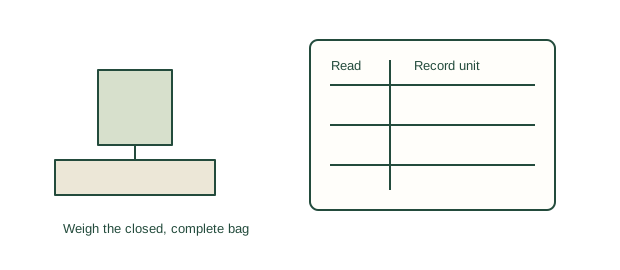
Suppose a fictional booking permits a 20 kg bag. That allowance is invented for arithmetic only and is not a statement about any airline, fare or route. The traveler obtains illustrative readings of 17.1, 17.3 and 17.2 kg from the same packed bag. These are made-up readings, not results from testing a scale. The 0.2 kg spread describes this imaginary set's variation; it does not establish that the scale is accurate within 0.2 kg.
They next expect to add items totaling roughly 1.6 kg. Adding that estimate to the highest illustrative reading gives 18.9 kg, leaving an apparent 1.1 kg below the fictional allowance. That is planning arithmetic, not a recommended universal safety margin. Packaging, other forgotten accessories and measurement error can still matter. If the apparent allowance becomes tight, the traveler reduces the load and weighs the complete final bag again instead of relying on subtraction alone.
A practical purchase decision follows from the return journey: if there will be no suitable scale where the bag is repacked, a portable scale may be useful. If the contents remain unchanged and comfortably within the real booking conditions, borrowing at home may suffice. Read the maker's operating instructions and the carrier's actual rules; a larger display or more decimal places does not by itself resolve either uncertainty.
Make a return-trip weight log
- Record the actual booking allowance, units, affected bag and official airline source. Include each relevant operating segment and any differences the carrier identifies for your fare or route.
- List everything that travels with the bag, including attached covers and straps. Weigh the complete closed load with a method appropriate to the equipment and comfortable for the person using it.
- Repeat the reading as the maker instructs and record each result rather than keeping only the lowest one. A noticeable spread is a reason to review the technique or equipment, not to claim calibration accuracy.
- Write down additions expected before the return, such as gifts and their packaging, alongside items genuinely removed. Treat the net change as an estimate until the final complete bag is weighed.
- Choose a personal planning margin in light of uncertainty and actual policy, then reduce the load if necessary. Recheck the final bag; do not assume any consumer scale overrules the carrier's measurement.
Is it worth adding to your kit?
Consider it if
Your luggage contents regularly change before the return journey.
Skip it if
You can weigh the packed bag at home and remain well below the relevant allowance.
COMPARE FEATURES, THEN CHECK THE LISTING
Explore the options
These are category search results, not a claim that every result fits this guide. Match dimensions, contents, care instructions, and seller details before choosing.
Search Amazon (paid link) ↗We may earn a commission from qualifying purchases. Prices and availability are shown by the retailer.
Common questions
Does a scale guarantee no excess baggage charge?
No. Carrier measurements, allowances and policies control the outcome. Treat your reading as a planning aid.
Is the highest capacity always better?
Not if the scale becomes awkward to hold or pack. Choose a usable range for the luggage you can comfortably handle.
Sources and editorial scope
Primary references support the product-category examples and documented features. Fit exercises, buying decisions, and existing-gear alternatives are Practical Trail editorial guidance. References were reviewed for this guide on October 13, 2026; specifications and product versions can change. This article does not present independent test results.
How our guides are prepared →