Camp lighting · RESEARCH-BASED BUYING GUIDE
Replaceable Cells or USB Rechargeable Lantern for Weekend Camping?
The practical battery choice is the one you can prepare and maintain consistently. A USB rechargeable lantern fits some household routines, while a compatible replaceable-cell design suits others. Choose the format around ordinary weekend use and the manufacturer's requirements, not a promise that one type will run forever.
As an Amazon Associate I earn from qualifying purchases. We have not hands-on tested the products discussed in this guide.
Write a realistic use schedule
Estimate the number of evenings and the approximate time you expect to light the table or tent. Decide which brightness setting suits the task rather than assuming maximum output throughout. Compare the manufacturer's runtime information at that setting. Treat it as a planning reference with stated conditions, not a guaranteed result for every battery, temperature, or pattern of use.
Check exactly what the lamp accepts
A replaceable-cell lamp may support only specified cell types, sizes, and arrangements. A rechargeable model may require a particular cable or battery pack. Black Diamond's Moji information describes a dual-fuel option, illustrating why the exact model and supported battery details matter. Do not assume all lamps with a removable cover accept every rechargeable cell that physically fits.
Compare the preparation routine
Look at where you charge or check equipment before leaving home. A rechargeable lamp is convenient if you reliably prepare it and bring the compatible cable. Replaceable cells can be straightforward when you have the specified type and follow the maker's handling guidance. Include spares, cases, and chargers in the packed comparison instead of comparing the bare lamp bodies alone.
Use the current format if it works
A lantern you already own may only need a more consistent pre-trip check. Put its preparation step on the gear checklist and follow the manufacturer's storage instructions between trips. Buy a different power format when a repeated routine problem remains, such as incompatible charging cables across your kit. Do not turn a convenience lamp into a substitute for appropriate equipment for the conditions and activities you plan.
A household-preparation example
Consider a camper whose household devices already charge from a small set of compatible USB cables. A rechargeable lantern may fit that routine if it can be prepared alongside them and its runtime suits the trip. Another camper may prefer a supported replaceable-cell lamp because that is the equipment they already maintain consistently. Neither habit proves one format is universally superior. Pack the real cables, chargers, or protected spare cells beside the candidate lamp and compare the complete kit. Then add a preparation reminder to the checklist. Changing battery format is useful when it removes a recurring inconvenience; buying another device without changing the forgotten pre-trip check may leave the original problem untouched.
Compare the practical approaches
| Power format | Fits a routine where | Extra check before the trip |
|---|---|---|
| Internal USB rechargeable battery | You already charge small devices at home and reliably prepare the lamp before departure. | Confirm the supported cable and source, charging indication, storage guidance, and runtime attached to the brightness setting you intend to use. |
| Specified replaceable cells | You maintain the exact supported cells and can store and carry them according to the lamp maker’s guidance. | Check size, chemistry, quantity, and installation instructions. Physical fit does not prove that an alternative cell type is supported. |
| Supported proprietary rechargeable pack | The exact lamp accepts that pack and you already have the intended charging arrangement. | Verify model and pack compatibility, what is included, and the complete packed package. Do not assume a battery is supplied because a photograph shows one. |
| Keep the working lamp and improve preparation | The present format meets the trip but charging or checking is routinely forgotten. | Add a practical checklist step and test the supported setup at home before buying another device with the same preparation problem. |
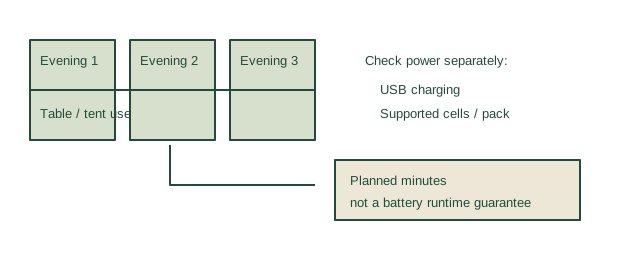
Illustrative evening-use budget, without a battery guarantee
This is a hypothetical planning example, not measured runtime for a product. Suppose a three-evening trip includes about 90 minutes of table lighting and 20 minutes of tent organization each evening. The schedule totals 110 minutes per evening and 330 minutes overall, or five hours and thirty minutes. It tells you how much planned use to compare with the maker’s runtime figures.
Do not compare that schedule automatically with the largest runtime printed on a package. Check which brightness setting and conditions accompany the figure, and whether your intended tasks use different settings. This arithmetic does not calculate actual battery capacity, cover every unplanned use, or guarantee that a nominal six-hour lamp lasts through the trip. Treat any uncertain specification as a question for the maker rather than filling it with a guessed margin.
If the lamp also charges another device, keep that demand separate because it shares the available energy. If a supported replaceable-cell format is involved, read the exact battery requirements and handling guidance. A useful home rehearsal checks controls, charging indication, and your routine; it should not become a made-up laboratory endurance claim published as product testing.
Make a power-format decision card
- Write the trip duration and the separate tasks you expect to light. Estimate normal use in minutes, then label those figures personal planning assumptions rather than manufacturer performance data.
- Record the selected lamp’s model and the setting connected to its runtime information. Keep high and low figures in different fields so they cannot be accidentally compared as one continuous operating mode.
- List the exact supported power format and any required cables, chargers, battery packs, or protected spare-cell storage. Compare the whole kit rather than the bare lantern weight.
- Choose a realistic preparation moment before departure, such as alongside the other devices you already check. Write down how the lamp signals readiness according to its instructions.
- After a normal trip, note whether the inconvenience was a forgotten preparation step, awkward connector, unsuitable controls, or insufficient planned capacity. Replace the device only when a different format addresses that specific cause.
Is it worth adding to your kit?
Consider it if
A different supported power format fits your existing preparation routine more reliably.
Skip it if
Your current lantern works well when you follow a consistent charging or battery-check routine.
COMPARE FEATURES, THEN CHECK THE LISTING
Explore the options
These are category search results, not a claim that every result fits this guide. Match dimensions, contents, care instructions, and seller details before choosing.
Search Amazon (paid link) ↗We may earn a commission from qualifying purchases. Prices and availability are shown by the retailer.
Common questions
Can I use any cells of the right size?
No. Follow the exact lamp's supported battery chemistry and handling instructions.
Does the longest advertised runtime describe full brightness?
Not necessarily. Compare the setting and conditions attached to the runtime figure.
Sources and editorial scope
Primary references support the product-category examples and documented features. Fit exercises, buying decisions, and existing-gear alternatives are Practical Trail editorial guidance. References were reviewed for this guide on October 13, 2026; specifications and product versions can change. This article does not present independent test results.
How our guides are prepared →